
Leadwork Services
Six details account for nearly all the leadwork on the houses of Prestatyn.
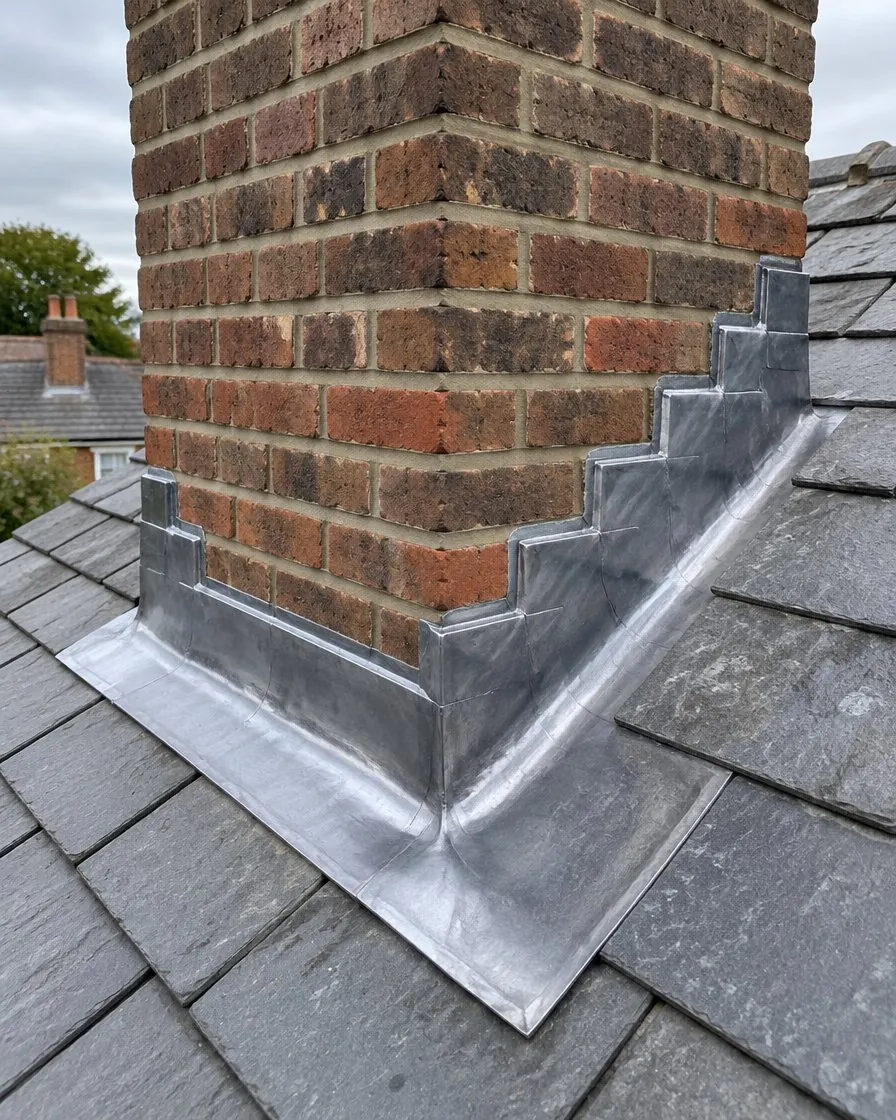
Chimney Flashings
Front aprons, step flashings up the sides, and the back gutter behind the stack, each dressed into a raked-out chase and wedged and pointed. The back gutter is the piece that fails most often and leaks worst.
Wall Flashings
Where a roof meets a wall above it, as at a lean-to, an extension or a dormer cheek, a cover flashing and soakers keep the junction dry. We renew these on Prestatyn extensions whose original mastic joint has given up.
Valley Linings
Open lead valleys in code 5 or 6 lead, laid over a valley board with welted edges and the correct laps so water can't be driven back under the slates in a Denbighshire gale.
Flat Lead Roofs
Bay window roofs, porches and small dormer tops in traditional lead, laid in bays with rolls or drips to allow for movement. On period houses in Prestatyn, LL19 lead remains the right-looking and longest-lasting choice.
Box Gutters
Parapet and box gutters lined in lead with proper falls, drips and outlets. Where a long gutter would need many joints we may recommend a GRP lining instead.
Bossed Details
Corners, chimney saddles and dormer tops formed by bossing, working the lead into shape without cutting and soldering, so there are no seams to fail.
Lead is where most roofs leak: around chimneys, along abutments and around roof windows. On slate roofs we dress lead to suit the slate gauge, and where a stain on a ceiling doesn't line up with any obvious flashing we do proper leak detection first.
Lead Specifications
Lead comes in codes by thickness, and using the wrong one is the commonest reason leadwork fails early.
Code Weights
Code 3 is for soakers only. Code 4 suits flashings and small aprons. Code 5 is the minimum for valleys, back gutters and anything that carries water. Code 6 and above for large flat areas and box gutters. We specify the code for each detail in the quote.
Sand-Cast vs Machine-Cast
Machine-cast (milled) lead is the modern standard and what we use for most work in Prestatyn. Sand-cast lead has a more irregular surface and is specified on some listed buildings and conservation work; we can source and work it where the conservation officer requires it.
Lead Repairs
Not every failed detail needs replacing. These are the three repair routes we use.
Patching
Small splits and holes in sound lead can be lead-welded or patched. It's a proper repair when the surrounding lead is thick and flexible, and a false economy when it isn't.
Dressing Down
Flashings that have lifted from their chase, often after storm or thermal movement, are dressed back down, re-wedged and re-pointed. A quick job that stops a lot of leaks across Prestatyn, LL19.
Partial Replacement
Where one piece, typically the back gutter or a valley section, has failed, we replace that piece and lap it correctly into the sound lead around it.
Why Lead Fails
Lead is one of the longest-lived materials on a roof, so when it fails there's usually a reason.
Thermal Movement
Lead expands and contracts with temperature. Pieces that are too long, or fixed so they can't move, fatigue and crack along the same line every time. The fix is the right size of piece and the right fixings.
Poor Installation
Flashings laid on the surface instead of into a chase, joints sealed with mastic, lead nailed through its face, and code 3 used where code 5 was needed. We see all of these on Prestatyn roofs every week and put them right.
Age
Lead eventually thins, especially on sun-facing slopes, and Victorian lead on some Prestatyn roofs is simply worn out after a century. At that point replacement is the honest answer.
Lead Alternatives and When We Use Them
Lead remains the best material for most flashings: it's easy to shape, lasts for decades when properly fitted and suits every type of roof. But it isn't always the right answer. On some properties in Prestatyn where lead theft is a concern, such as outbuildings, commercial units and empty properties, we can fit lead-free alternatives that look similar and are of no value to a scrap dealer. GRP valley troughs are a reliable and lower-cost replacement for lead valleys on tiled roofs, and modern roof windows come with their own engineered flashing kits.
Where a lead alternative is used we follow the manufacturer's details exactly, because these products are less forgiving than lead if they're cut short or poorly dressed. On listed and period buildings we stick with traditional lead to match the original work.
Signs Your Leadwork Needs Attention
Lead problems usually show up inside before anyone notices them on the roof. Look out for damp patches on a chimney breast, staining where an extension meets the main wall, or water in the loft after driving rain. From outside, the warning signs are lead that has lifted away from the wall, mortar that has fallen out of the joint the flashing is tucked into, cracks or splits in the lead itself, and white powdery staining which shows the lead is corroding.
Many of the leaks we trace in Prestatyn, LL19 come from flashings that were patched with mastic or flashband rather than repaired properly. These products buy a year or two at best; once they fail, water has often been tracking into the structure unseen for a long time.
How Lead Should Be Fitted
Good leadwork is a craft. Each piece needs to be the right code for its job, cut to lengths that allow it to expand and contract without splitting, fixed with clips rather than nails where it's exposed to wind, and wedged and pointed into the brickwork rather than glued to it. The Lead Sheet Training Academy publishes detailed guidance on all of this, and it's the standard we work to on lead across Prestatyn. We photograph the finished work so you can see how it's been done.